Tokenmaxxing, the data center panic, and what usage for a company like ours actually looks like.
I’ve been wanting to write this post for months. The problem wasn’t having something to say. The problem was I couldn’t find the equation.
Two conflicting pressures have been running in parallel in the AI conversation. One says you’re not using enough: “AI-first” companies are mandating that engineers burn tokens worth multiples of their salary, and doing anything less signals you’re not serious. The other says you’re using too much: AI is consuming catastrophic amounts of energy, feeding a data center crisis, and responsible companies should feel conflicted about it.
Both of those stories are incomplete. And the only way to say that with any confidence is to actually check the numbers – which providers don’t exactly make easy.
The Tokenmaxxing Problem
The term “tokenmaxxing” entered the mainstream in early 2026, but the underlying idea had been building since OpenAI released its o1 model in late 2024 and introduced test-time compute scaling – the idea that spending more tokens at inference time produces better model answers. The logic drifted from there: if more tokens means better output from the model, then more tokens consumed by your organization must mean more productivity.
The statement that made this explicit came from Nvidia CEO Jensen Huang at GTC 2026. Huang proposed that engineers should receive token budgets on top of their base salaries and set a specific benchmark: “If that $500,000 engineer did not consume at least $250,000 worth of tokens, I am going to be deeply alarmed.” He compared an engineer not using AI to a chip designer insisting on paper and pencil instead of CAD tools. (Tom’s Hardware, CNBC)
It’s worth noting that Nvidia sells the hardware that runs those tokens. Jensen Huang’s benchmark is not a neutral observation about productivity.
A Meta employee built an internal leaderboard called “Claudeonomics” tracking token consumption across 85,000 employees. Over 30 days, the company collectively burned 60 trillion tokens. The top individual averaged 281 billion. Meta shut the leaderboard down after employees started leaking the data. (Fortune, The Decoder)
By May, Fortune was running the headline: “Tokenmaxxing is over. It was a flawed way to measure a company’s ROI from AI.”
The core problem is simple. Token count measures input to the AI, not what comes out. A developer who sends 200 prompts to accomplish a task that a better-structured prompt handles in 20 has used 10x the tokens and produced the same result. Under tokenmaxxing logic, that developer is performing better. It’s the same reasoning that measures software productivity by lines of code written, or SEO specialists by how many site visits they generate, and both fail because nonsense has always been cheap and plentiful on the internet.
The Multi-Agent Spiral
The more expensive version plays out in multi-agent supervisory architectures. The pitch is compelling: multiple AI agents with defined roles, coordinating and reviewing each other’s work, a supervisory agent approving outputs before they proceed. Autonomous. Self-correcting.
In practice, these systems have a persistent failure mode. An agent produces output. The supervisor critiques it. The first agent revises. The supervisor critiques the revision. The loop continues for far more cycles than any human would tolerate before escalating. Each cycle burns tokens and – more expensively – requires human review time to determine whether the loop is converging or just spinning.
The tell is in the review queue. You open it expecting to approve something and instead find yourself reading the same argument restated four different ways, each revision responding to the last critique without ever resolving the underlying question. Nothing is wrong with any individual output. The problem is that no one – no agent, no supervisor – had the authority to say “this is good enough, ship it.” So they kept going. The tokens burned. The queue filled. You make the call a human should have made two hours earlier, and the final result looks roughly like what the first draft would have looked like with better prompting.
People create these spirals too. Committees and revision loops can also run forever. But when you’re at a desk, you can tell the difference between a review cycle that’s producing value and one that’s burning time, and you stop it. The organizational failure mode of tokenmaxxing is that it removes the incentive to stop. More cycles, more tokens, better metric.
AI Is Not a Feature. Or a Protocol.
There’s a related failure mode in the vendor space: companies ship products with AI labels on features that don’t need them, treating “AI-powered” as a differentiator regardless of whether it changes the outcome. I think about this the same way I think about Bluetooth. Bluetooth has never sold a product on its own – it’s a protocol, a technology layer. Its value comes entirely from what it enables.
“AI-powered” is the same. It tells you nothing. The value depends on whether it’s applied to the right problem with the right tooling around it. Part of what makes Kiro work well for us isn’t the model – it’s the IDE and CLI tooling that guides the model, keeps it scoped to the project context, and prevents it from doing open-ended internet-chatbot things unless you explicitly ask. The tooling around the model is where the leverage is. The model itself is closer to the protocol layer. We covered this in depth in our April 2026 post on how we use AI.
Both failure modes – tokenmaxxing internally, AI-as-label externally – share a root cause. Token consumption is visible, measurable, and easy to report. Value delivered is harder to quantify. Organizations optimize for what they can measure, and end up very good at measuring it.
At Human Element, the directive is simple: if a task will take longer with AI, produce worse output, or be harder to do, don’t use it. No consumption targets.
The Pricing Shift Worth Watching
Token consumption habits also create a specific financial exposure that doesn’t get discussed enough.
AI tools launched with flat, unlimited pricing because the goal was adoption. Build the habit first, reprice when switching costs are high. That playbook is not new – it’s how most enterprise software has developed. With AI, the adoption phase was faster and the habit runs deeper, because the tools are genuinely useful.
The repricing is underway. It shows up in enterprise tier segmentation, rate limits on “unlimited” plans, and the gradual definition of what “unlimited” actually means in practice. Organizations that built “maximize AI consumption” into their culture are the most exposed, because their operations are now entangled with a pricing tier they don’t control.
The practical hedge is this: open-weight models like Llama 4, Mistral, Qwen, and DeepSeek are currently scoring within 3 to 5 percentage points of frontier proprietary models on standard benchmarks, while costing 80 to 95 percent less per token via third-party API providers like Together AI, Groq, and Fireworks. (Eden AI, 2026) You can run these models on AWS or any cloud GPU provider at transparent, commodity-linked rates.
Most agency-level work – code generation, documentation, ticket structuring, analysis – doesn’t require frontier-level reasoning on every task. Building habits around value rather than consumption means that if the pricing changes, you adapt. You never built workflows that only work at a specific price point.
The Energy Question
I started trying to answer the energy question months before I could.
Emily Kania, our marketing director, was researching carbon offset options and needed to know what our AI usage actually looked like in energy terms. The answer was not available from our vendors. Anthropic doesn’t publish per-query energy data. Neither does AWS. Neither does Kiro. The “how much energy does this use” question returns nothing from the providers themselves. The data exists. It’s just not shared.
I spent months trying to reverse-engineer it from published studies and hardware specs, and kept hitting numbers that were either too high-level to be useful (“AI uses a lot of energy”) or too specific to a single provider’s internal accounting to apply broadly.
Our senior developer Mike Erickson put the underlying anxiety into words plainly: “I always have in the back of my mind just how much compute power in some random data center I might be spooling up.” That’s the honest version of the concern. It’s also exactly the question this equation lets you answer.
What unlocked it was finding an equation in The Multiverse School’s AI Problems Index built from first principles:
Wh/query = (GPUs × TDP × seconds) ÷ concurrency ÷ 3600 × PUEEach variable has a defensible, sourceable value. Each has uncertainty, but bounded uncertainty – conservative to liberal estimates are definable. Once I had the equation, the rest was sourcing the variables.
What the Equation Is Really Asking
Here’s a useful way to frame what this calculation actually does: if Human Element needed to operate its own dedicated slice of a data center – hardware spec’d identically to what Anthropic uses, performing just as well – what would that infrastructure look like?
Our 32-person team, running at the rates we actually use, needs about 400 watts of dedicated compute at peak. That’s roughly the power draw of a desktop running at full load. A typical hyperscale data center runs 100,000 kW or more. Our slice is 0.4 kW – about 0.0004% of that.
For fun: a single 400W solar panel, given average US sun hours, produces about 584 kWh per year. Our annual AI consumption is 402 kWh. One panel covers it with room to spare.
I’ve joked about solving this with a shed full of Mac Minis and some solar panels. The spirit is right – our compute needs are small enough to think about in those terms. In practice it doesn’t hold up. Running current-generation models on an M-series Mac Mini means using significantly smaller, less capable open-weight models, not Claude 4. The inference quality isn’t equivalent. And data center hardware, running at high utilization with professional cooling and longer replacement cycles, is more efficient per useful computation than consumer hardware churning away in a shed. The existing shared infrastructure, counterintuitively, is the more efficient choice for the work we’re actually doing.
For the curious: a single NVIDIA DGX H100 server – one 8-GPU inference node – runs approximately $200,000–$300,000. At our utilization rate of about 6.25% of one node, our proportional hardware cost would be roughly $12,000–$19,000, amortized over a 3–5 year lifecycle. Cloud pricing doesn’t work this way, but it puts a number on the physical infrastructure behind 402 kWh/year.
The Numbers for Human Element
| Variable | Value | Source |
|---|---|---|
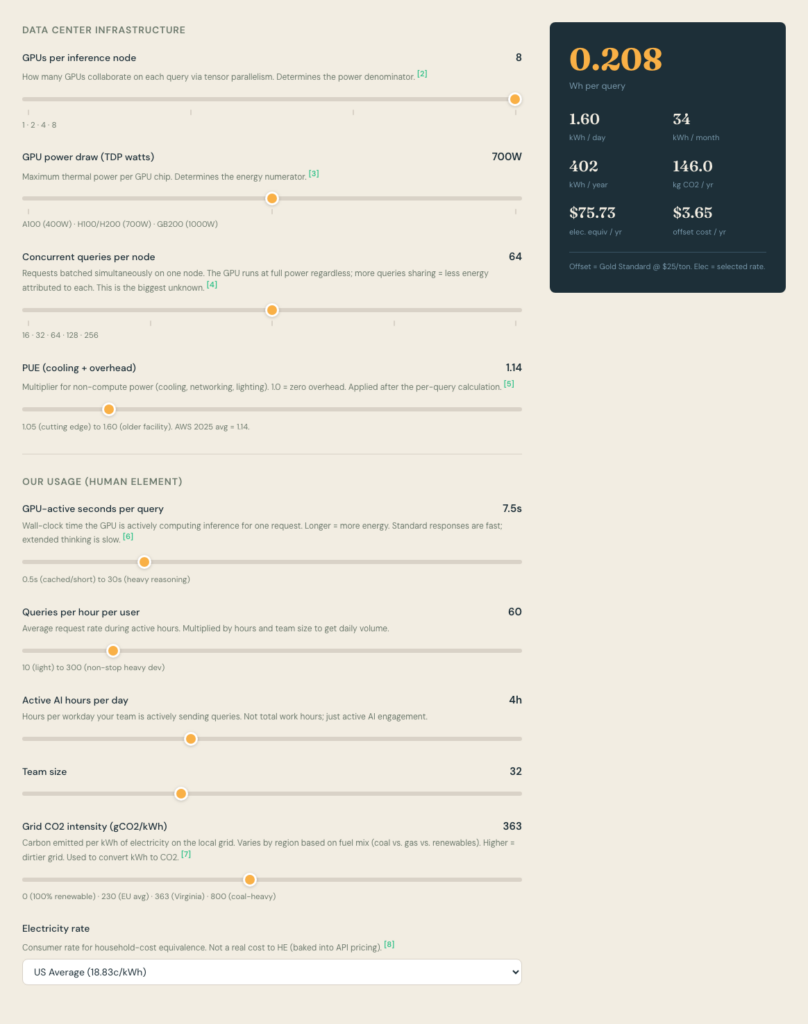
| GPUs per inference node | 8 | NVIDIA DGX H100/H200 User Guide |
| GPU TDP | 700W | NVIDIA H100 SXM Datasheet |
| GPU-active seconds per query | 7.5s | Digital Applied Latency Benchmarks, Apr 2026 |
| Concurrency per node | 64 | JarvisLabs “Scaling LLM Inference” (2026); NVIDIA Inference Deployment Guide |
| PUE | 1.14 | Amazon 2025 Sustainability Report via GeekWire |
| Grid emissions | 363 gCO2/kWh | EPA eGRID, Virginia/PJM subregion |
| Team: 32 users, 60 queries/hr, 4 active hours/day | – | Human Element estimates |
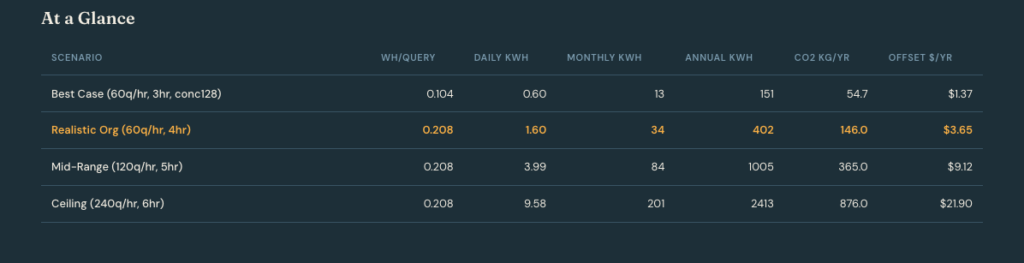
Result: 0.208 Wh per query. For comparison, a Google search uses approximately 0.3 Wh. Our AI queries cost less energy than a search.
Annual org totals:
- Daily: 1.60 kWh
- Monthly: 34 kWh
- Annual: 402 kWh
The US average household uses 10,220 kWh per year (EIA). Our entire 32-person team’s annual AI usage is less than 4% of one household – roughly 14 days of one house’s electricity for a full year of work.
Annual CO2: 146 kg. That’s approximately the emissions from driving a gas car 360 miles. One round-trip flight from Detroit to New York produces more than double that.
This covers our primary Kiro and Claude usage – direct, human-in-the-loop work. We also have automated AI usage: API integrations, agent workflows, background pipelines. That runs on metered billing separately. Our total OpenAI API spend covering all automated workflows since 2025 has been $41.91. Both categories are small.
Comparisons That Actually Help
The data center coverage deals in units designed for hyperscaler scale – megawatts, terawatt-hours, national grid percentages. Right units for Meta burning 60 trillion tokens a month. Wrong units for a 32-person agency, and applying them without distinction is how the anxiety spreads beyond where it’s warranted.
A few comparisons that gave me better intuition:
1 hour of YouTube streaming = more CO2 than 1,000 AI queries. One hour of HD video streaming produces 42g of CO2 and consumes 120 Wh, according to TRG Datacenters research reported by ITWire, December 2025. To the extent AI replaces time spent watching tutorials, browsing documentation, or loading multiple web pages, it may represent a net reduction in energy per task.
Offsetting our entire annual footprint costs $3.65. Gold Standard verified carbon credits run about $25 per metric ton (Senken, 2026). Our 146 kg annual CO2 works out to $3.65 via Gold Standard, $1.21 in RECs (callmepower.com), $7.30 via Verra VCS. Even Direct Air Capture – the most permanent offset method – runs $58.40 for our annual footprint.
At our scale, we are not the cause of new data centers. Existing servers draw 60–80% of their peak power regardless of utilization (DOE). Average server utilization runs 12–18% (Fortune, Aug 2025). AI inference fills that gap. Our 402 kWh/year is a rounding error in existing facility capacity.

The honest caveat: the IEA reported 17% year-over-year growth in global data center electricity demand in 2025, driven significantly by AI at hyperscale (IEA). At massive scale – hyperscalers running training clusters and consumer AI services – that growth is real. Virginia passed a data center electricity tax in 2026 after residential electricity bills rose to subsidize expansion (InsideClimateNews). These are real concerns. The distinction is between the organizations driving that growth and a 32-person agency’s 402 kWh annual footprint. The anxiety those stories generate tends to land on everyone equally; the underlying responsibility doesn’t.
Who actually benefits from the “we need more data centers” narrative? Hyperscalers framing their growth as national infrastructure. Land speculators buying near planned facilities. Energy companies seeking favorable regulatory treatment. Not small agencies. Not the communities hosting the buildout.
The Calculator
So I built an interactive calculator to run the numbers properly.
I’m not publishing it as a public tool – the methodology note at the top is blunt about its limitations, and I’d rather show the outputs than invite people to misconfigure the sliders and walk away with a number they trust more than they should. But the screenshots below show what it produces at each preset, and the equation and source citations are all included in this post if you want to verify the math yourself.
The biggest uncertainty in the model is concurrency – how many queries share a GPU node at any given moment. That single variable moves the Wh/query estimate by a factor of 8 across its full range. The fact that Anthropic doesn’t publish this number is, itself, a data point worth noting.
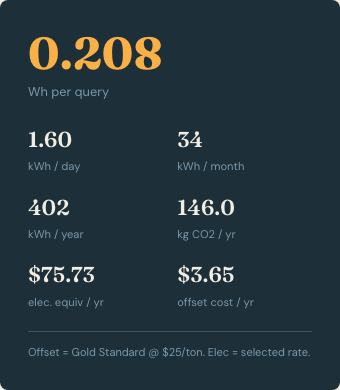
The four preset scenarios, computed directly from the variable values:
| Scenario | Wh/query | Annual kWh (32 users) | CO2 kg/yr | Offset $/yr |
|---|---|---|---|---|
| Best Case (60q/hr, 3hr/day, concurrency 128) | 0.104 | 151 kWh | 55 kg | $1.37 |
| Realistic Org (60q/hr, 4hr/day, concurrency 64) | 0.208 | 402 kWh | 146 kg | $3.65 |
| Mid-Range (120q/hr, 5hr/day, concurrency 64) | 0.208 | 1,006 kWh | 365 kg | $9.12 |
| Ceiling (240q/hr, 6hr/day, concurrency 64) | 0.208 | 2,413 kWh | 876 kg | $21.90 |
These scale linearly with team size. A 100-person company at Realistic Org settings: roughly 1,256 kWh annually, offset around $11. A 500-person company at the same settings: about 6,281 kWh, offset under $57. At the Ceiling scenario, a 500-person company’s annual AI footprint costs under $400 to offset in full.
None of these numbers represent a crisis at the organizational level.
The Metric That Actually Matters
Token count doesn’t tell you whether AI helped. Energy consumption doesn’t tell you whether the work was worth it.
There’s a framework for this. In project management and service work, the conventional wisdom is that you can have work that’s good, fast, or cheap – pick two. Good and fast isn’t cheap. Good and cheap isn’t fast. Fast and cheap isn’t good. The triangle holds because improving one corner usually comes at the expense of another.
Genuine technological improvements break that constraint. The right tool applied to the right problem moves one corner without harming the other two.
At Human Element, the honest answer – for specific tasks – is that all three corners are moving in the right direction:
Better. AI unlocks work that simply wasn’t achievable within a reasonable budget before. Synthesizing a month of application logs to find patterns and produce an incident report used to be impractical for a 30-client agency. Now it’s a ticket. Strategic URL mapping that required a full day of manual analysis gets done in 30 minutes with more thoroughness than the manual version. That’s not faster work – it’s work that genuinely wasn’t on the table before.
Faster. Timelines are more predictable. Context that used to fall through the cracks of a busy day gets captured. Tickets get closed out more completely. Documentation happens during the work rather than after.
Cheaper. We’ve now done the energy math, and that cost is negligible. The other cost – the editorial overhead, the supervision, the critical thinking required to do this well – is real, and it’s why we don’t run autonomous pipelines and call it done. But when you account for the actual output quality, the work we’re doing with AI-assisted workflows is less expensive per deliverable than what came before it. Not because AI replaced anyone, but because friction went down.
The tokenmaxxing companies were optimizing for a proxy metric because the real one is harder to measure. That’s understandable. It’s also how you end up in Fortune as a cautionary tale by May.
As AI pricing evolves – and it will – organizations that built consumption habits around unlimited pricing will face a repricing they can’t easily unwind. The ones that built habits around value have a simpler path: keep doing what works, adjust what doesn’t, don’t be exposed to someone else’s pricing decisions.
Conclusion
I started this post with two pressures running in opposite directions: use more AI or you’re falling behind; feel guilty about your AI use because of the environmental cost. Both are real. Neither helps you make a better decision.
The better decision requires actually looking at the numbers, and being honest about what they say and don’t say. At our scale, a single AI query costs less energy than a Google search. Our organization’s entire annual AI footprint offsets for $3.65. The environmental concerns driving data center coverage are legitimate – just not at the scale of a 32-person agency’s usage, and it’s worth being clear about where the responsibility actually sits.
The habit of using AI where it genuinely helps – rather than everywhere as productivity theater or nowhere as environmental virtue signaling – is also the practical hedge against the pricing changes that are coming.
If you want to talk about building workflows that optimize for output rather than consumption, we’re easy to reach.