Never Wrong, By Design
Instead of questioning the sugar coated, flattering answer from each Google search, users accept it as canon.
According to Google’s AI Overview, there are over 4 billion searching users. Many arguably fall into a category unaware that AI aggregation — the process of using artificial intelligence to automatically collect, organize, and synthesize vast amounts of information from multiple sources — has manipulated the bridge of trust that searchers previously held with professionals. By synthesizing its output, pulling from multiple sources, and then outputting an answer presented as a “fact,” the ability to differentiate between right and wrong becomes increasingly more difficult. This is not to say that Google is always wrong, but to say that it does not know when it is wrong. Users have stopped asking how a claim earns the right to be believed, hence our epistemological crisis: how do we really know what is true?
Take AI Overviews, for example. Google pulls from dozens of sources, blends those sources into one clean paragraph, and calls it an answer. This leaves no links to chase, no sources to weigh, just a verdict. The zero-click result does the same thing from the other direction. Before you’ve even formed a real question, you’re looking at an advertisement. In both cases, the moment where you would have pushed back is fading away.
The “Zero-Click” web is yet another pitfall. David Pierce, editor-at-large and co-host of The Vergecast, raised this exact point on episode “Jony Ive’s Funky Ferrari.” When you google something as simple as “What is the best computer to buy?” most of the time it returns an advertisement before an answer. Pierce pointed out that Google isn’t answering your question anymore, only redirecting it. What the algorithm sees is, “What is the best computer for ME? And where is the quickest place to buy it?” This redirection of attention creates a user dilemma, pointing them towards a purchase and not an answer, and forcing traffic in the direction of Google’s priorities and not the user’s. When a separate user then searches the exact same query — but from a different state, income-level, age, (or any other analytic/demographic Google tracks) — the answer varies. If a user accepts this “truth” that the AI engine has confidently asserted, then the search ends. In turn, quicker searches will significantly reduce traffic to academic and journalistic content, thus reinforcing the algorithm to repeat its directive, instead of informative, answer for each user.
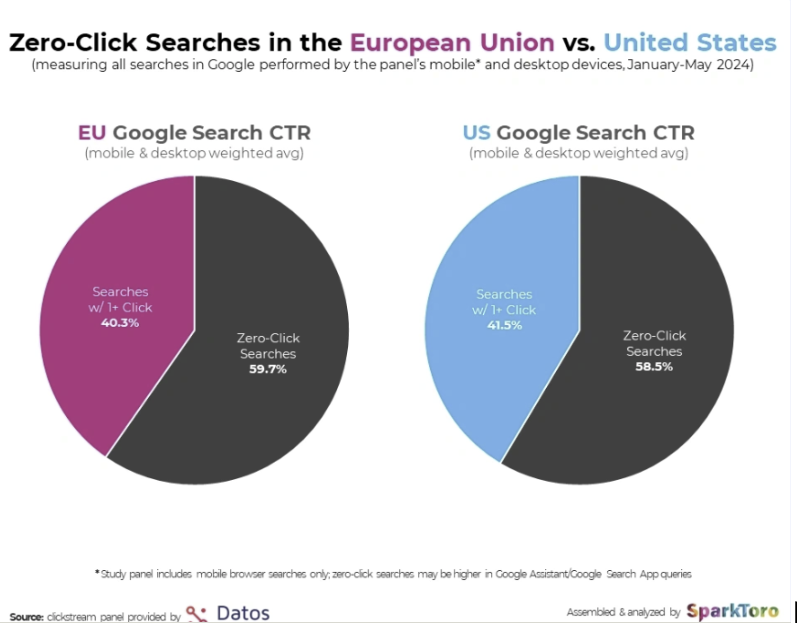
“According to Datos statistics, 58.5%of searches in the US do not result in the user clicking on a result in the SERP.” – Explodingtopics
Google is now orchestrating a biased engine with Webster Dictionary-level confidence. If I had to guess, since this is a capitalist country, I would confidently agree with “The Vergecast” in that they’re looking for traffic to increase in scenarios resulting in a purchase. As a publicly traded company, they have a priority and legal obligation to drive revenue and growth for their shareholders. The problem is that most Google users do not see them as a company, but instead as an oracle. Especially with a new atmosphere forming around platforms such as TikTok and Instagram that are built on the premise of scroll, consume, move on. No questioning, no verifying, just the next piece of content. Does that doomscrolling habit stay on the app? How many times in your life have you heard “just google it?” After you finish counting, how many times have you searched the web and questioned the first result?
Now, let’s say you do question it. Google sees this as a failed interaction, ending in no click, no purchase, and no monetary gain. So the algorithm does what it was designed to do and redirects. Every unanswered query becomes another data point to push the next result toward a transaction instead of an answer. This creates more engagement within the parameters that truth does not equal a successful search, and the algorithm then trains itself accordingly for the next session.
The Tip of the Iceberg
One man on the case is Rand Fishkin, founder of Moz, CEO of SparkToro, and one of the few people who has been calling Google out by name for years. He conducted a study on Google’s “NavBoost” after receiving anonymous tips from former Google employees in 2024. The ex-employees made claims that contradicted the company’s own public statements, and Fishkin calls what they revealed, “only the tip of the iceberg,” including but not limited to: geo-fences, cookie history, scores for user intent, and tracking engagement on searches before and after the initial query. He even alleged, “during the Covid-19 pandemic, Google employed whitelists for websites that could appear high in the results for Covid-related searches” and similarly during elections! The source was later revealed in Fishkin’s blog, “An Anonymous Source Shared Thousands of Leaked Google Search API Documents with Me; Everyone in SEO Should See Them,” as Erfan Azimi, an SEO practitioner and founder of EA Eagle Digital. Azimi asked this quote be included in the post: “An eagle uses the storm to reach unimaginable heights.” – Matshona Dhliwayo.
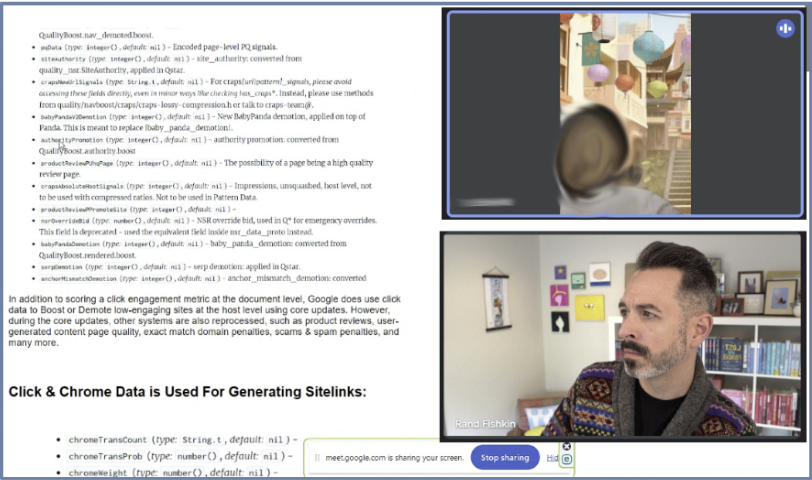
“An anonymized screen capture from Rand’s call with the source” – SparkToro, 2024
Later in January of 2026 Fishkin ran another experiment posted on his New Research: AIs are highly inconsistent when recommending brands or products; marketers should take care when tracking AI visibility blog where 600 volunteers ran twelve prompts through ChatGPT, Claude, and Google’s AI a combined 2,961 times, testing whether these tools return consistent answers. They don’t. The numbers were staggering: Less than a 1-in-100 chance that ChatGPT or Google’s AI gives you the same list twice if you ask the same question 100 times. Trying to get the same list in the same order? Closer to 1 in 1,000.
Killing the Visible Answer
If personalized, engagement-driven search quietly killed the shared answer, AI Overviews and AI Mode are killing the visible answer by removing your ability to see the sources and decide for yourself. The old ten-links format was at least transparent about its mess. You could see a sketchy site ranking high, click around, figure something was off. The AI layer takes that same problematic and misleading output, blends it into one smooth paragraph, cuts out the speed bump of comparing sources, and presents it as fact. The last moment where you have to use your judgment gets optimized away as a “friction point.”
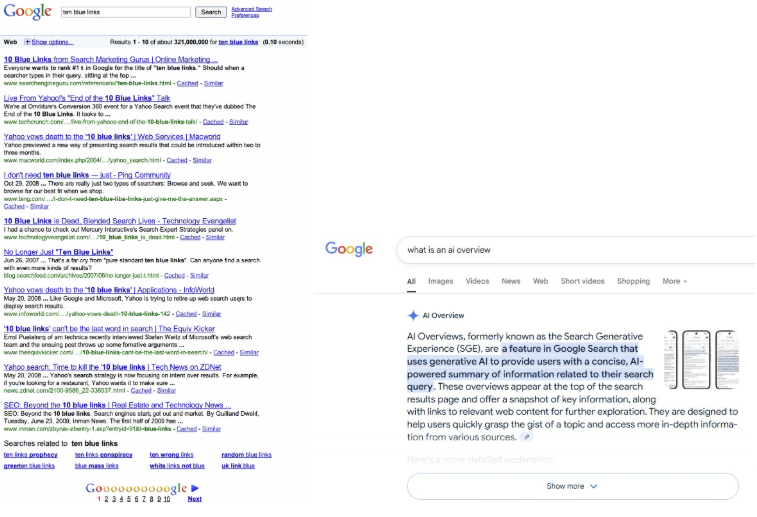
10 Blue Links (left) vs. AI Overview (right)
Reaching New Heights
So how can we reach new heights, considering the storm is getting worse? One amazing line in the comments on Fishkin’s piece came from a reader explaining why he still reads the blog instead of an AI summary: “I want the source, not the summary.”
- Take Google search answers with a grain of salt (especially the AI Overview)
- Search with keywords, not full questions
- Build rapport with sources, not summaries
- Blogs
- Case Studies
- Journals
- Customer Reviews
- Phone a friend?
- Test, fail, and try again
- Be skeptical, not content
Final Thoughts
Kafka built entire worlds out of one idea: the paralysis of people who stop fighting the system and become content with it. Gregor Samsa didn’t lose when he transformed into an insect. He lost when he stopped trying to get out of the room they shut him in.
That is the quiet cost of the zero-click web. Every time we accept the first answer without question, we are choosing the room. We let the summary stand in for the search. We let the confident paragraph stand in for the judgment we used to do ourselves. We are witnessing a monopolist search engine remove the human element of critical thinking, but it only works if we let it. It all starts with a willingness to look a little deeper. Do not simply accept the first answer, but instead find confidence in revealing the right answer.